What's new in Squidler
Keep it in the EU
September 25, 2026 · 3 min read
Your organisation can now choose where its AI processing happens. Choose the EU and everything your agents think with stays inside it. One setting, every agent, changeable whenever you like.
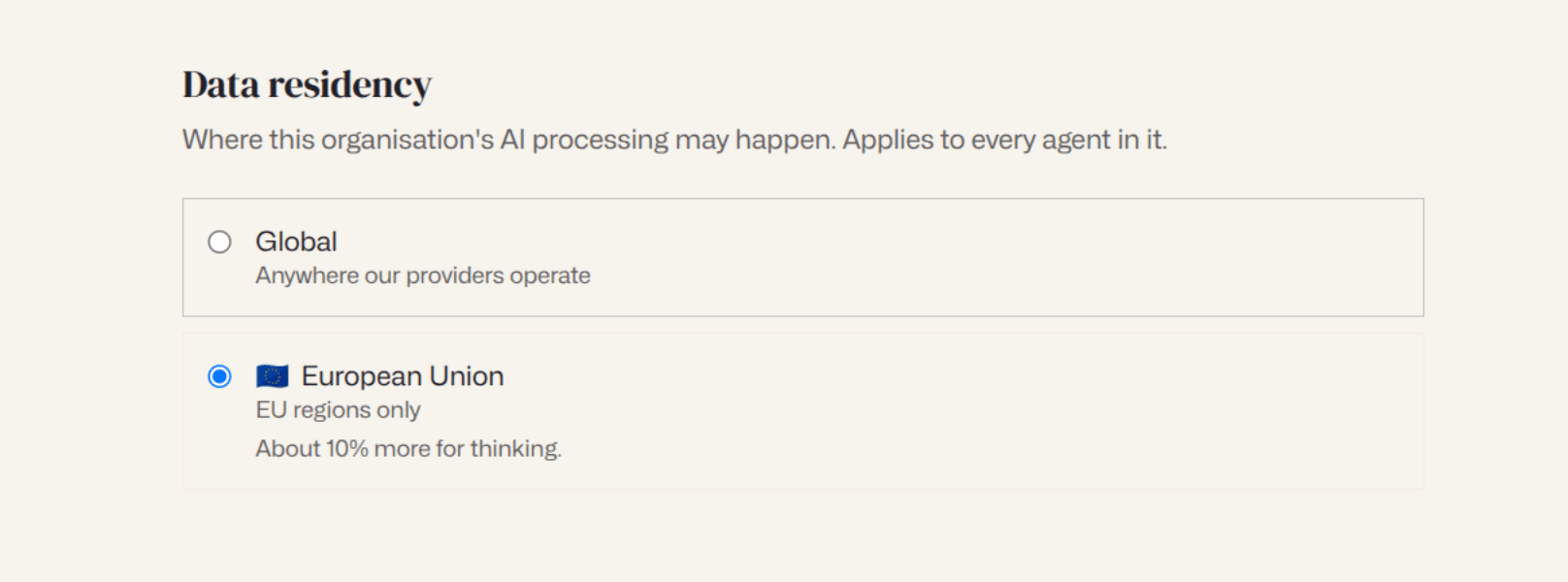
An organisation in Squidler can now choose where its AI processing happens. There are two answers: Global, which is what you have today, and the European Union, which keeps that processing inside the EU. It is one setting on your organisation's page, it applies to every agent in that organisation, and you can change it back.
What it covers
Every message your agents read, everything you dictate to them, everything they produce, everything they remember about your work: the processing behind all of it happens inside the EU. Not most of it — all of it.
That distinction is the whole point, because "EU" is a claim a lot of products make about one part of what they do and leave you to assume about the rest. We would rather have shipped nothing than a residency setting with a hole in it — an agent that quietly sends part of your data elsewhere is worse than one that does not offer the setting at all, because you would have no way to know.
That is also why there is no per-agent version of this. Residency belongs to the organisation, and every agent in it moves together. A setting where two of your colleagues' agents were in different jurisdictions would be a setting that means nothing.
It costs about 10% more
Not free, and we would rather say so on the button than in an invoice.
Keeping the work in the EU costs us around 10% more than letting it run wherever it is cheapest, and that is what you pay. The figure is not a guess — we read it from our providers' own published prices — and you see it on the option before you choose it, not afterwards.
What it does not do
It does not move work you have already done. Switching changes what happens from now on. Conversations you have already had, files your agent has already read, memories it has already formed: those stay exactly where they were processed at the time. Nothing is migrated and nothing is reprocessed.
It is not a certification. This is a statement about where your data is processed, which is a real and checkable thing, and it is not the same as a compliance programme. If your procurement people need more than that, talk to us — we would rather have that conversation than have you infer an answer from a marketing page.
It does not change who can see your data. That has always been the same: your agents are yours, and sharing one is something you do deliberately.
It does not cover email delivery. When an agent emails you, or you email it, that message travels through our email provider, which is not in the EU. Residency is about where your data is processed; it cannot govern the route a message takes to a mailbox that may well sit in another country itself. Moving email delivery into the EU is the next thing on this list — until it lands, every other way of working with your agents keeps the whole thing inside.
Switching back
You can. It is the same control, and it takes effect for everything that happens after.
We do warn you on the way out, more firmly than on the way in, for a reason that has nothing to do with sales: moving to the EU narrows where your data can go, and moving back widens it. Widening it affects everyone in the organisation, including colleagues who were not the one clicking. A confirmation that says so is the least a setting like this owes you.
Where to find it
Your organisation's page — every account has one, including the one that is just you. If you administer more than one organisation, each has its own setting, because each is a different set of people and a different answer.
If you are a Swedish or German company that has been putting off the question of where your AI processing happens, it is now a click.